
From Click to Connection: How Do Outdoor Brands Make Their First Impression on there homepage?
The homepage serves as the digital storefront for brands. My question in this article is to ask how much the first impressions matters? What some of the biggest bands do? I’ll explore the initial visual and technical elements employed by Salomon, Patagonia, and The North Face.
Salomon:
From Alpine Workshop to Global Outdoor Innovator
Founded in 1947 by François Salomon in Annecy, France, Salomon is a globally recognized brand specializing in equipment for trail running, hiking, skiing, and snowboarding. The company is renowned for its high-performance products and athlete-driven designs.
A significant milestone for Salomon was the introduction of the “le lift” ski binding in 1957, which revolutionized ski safety and performance. By 1972, Salomon had become the world’s leading ski binding manufacturer, selling over a million pairs annually. However, in 1994, the company faced financial challenges, reporting a $399 million loss due to market volatility and accounting errors.
Homepage as of Jan 2025:
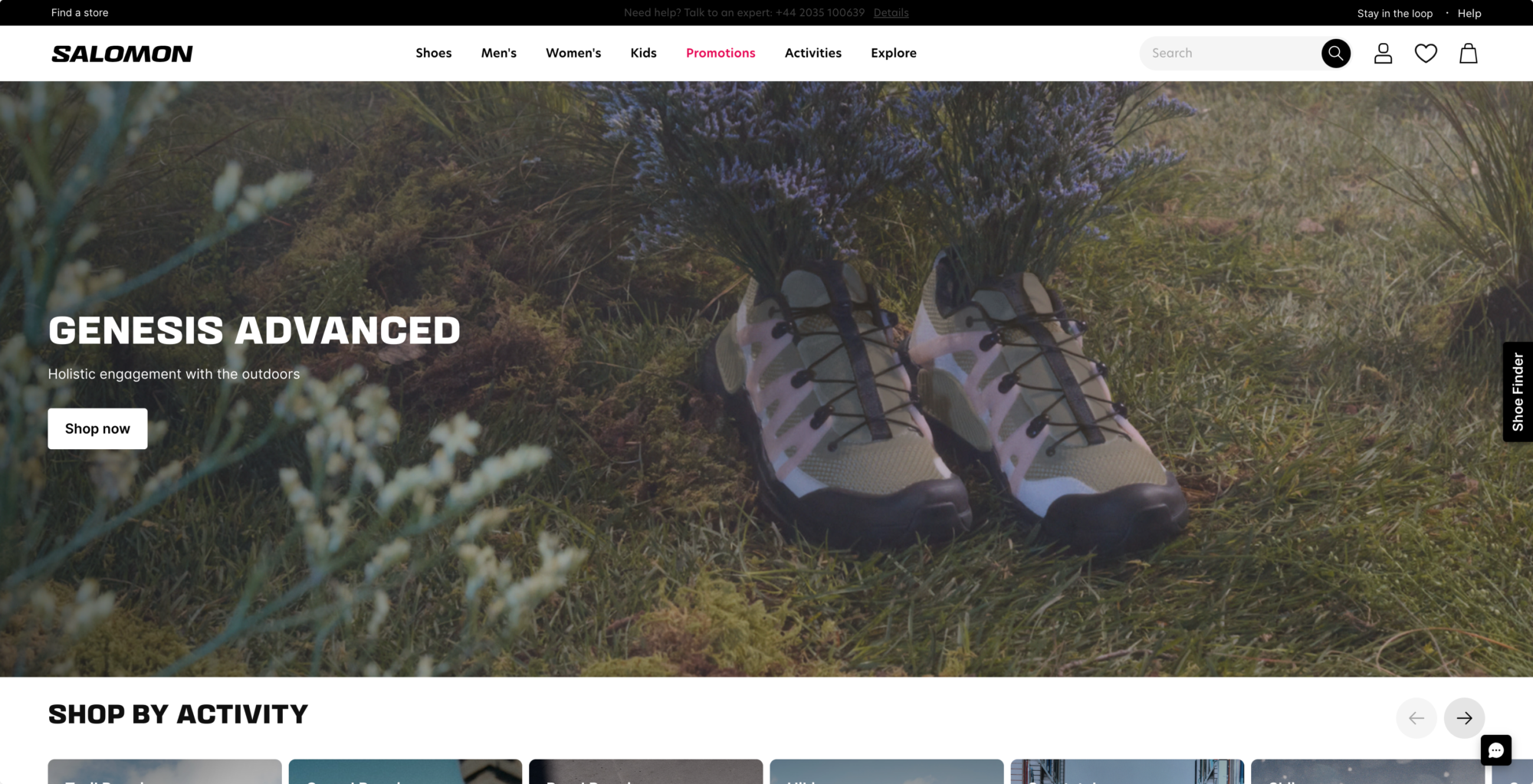
First thing the eye sees:
Hero is a single image at a fixed aspect ratio, with a simple CTA of text and button.
Tech:
Next.js (React Framework)
Salesforce Embedded Chat
Google PageSpeed Insights:
Performance Values are estimated and may vary*
Core Web Vitals Assessment: Passed

GTMetrix:

Patagonia:
A Legacy of Environmentalism and Innovation
Established in 1973 by Yvon Chouinard, Patagonia is an American company specializing in outdoor apparel and gear, with a strong emphasis on environmental sustainability. The brand is known for its high-quality, durable products designed for activities like climbing and surfing.
In 1985, Patagonia co-founded the “1% for the Planet” initiative, pledging 1% of sales to environmental causes, resulting in over $140 million donated. In 2022, founder Yvon Chouinard transferred ownership of the company to a trust and nonprofit organization to ensure that all profits are used to combat climate change and protect undeveloped land. Despite its environmental commitments, Patagonia has faced challenges, including internal audits revealing labor abuses in its supply chain in 2007 and 2011.
Homepage as of Jan 2025:

First thing the eye sees:
Hero is a large background loop video with a small subject line and button to watch the video.
Tech:
Salesforce Commerce Cloud (Demandware)
Klaviyo
Google PageSpeed Insights:
Core Web Vitals Assessment: Passed

GTMetrix:

The North Face:
Pioneering Outdoor Innovation
Founded in 1966 by Douglas and Susie Tompkins in San Francisco, California, The North Face began as a small retail store offering climbing and camping equipment. Today, it is a prominent American outdoor recreation company specializing in high-performance apparel, footwear, and equipment for activities such as climbing, skiing, and backpacking.
The North Face has been a pioneer in product innovation, introducing the geodesic dome tent, which enhanced stability and durability, becoming a favorite among mountaineers. In 2000, the company was acquired by VF Corporation for $25.4 million. However, it has faced challenges, including financial difficulties in the late 1980s and a controversy over inflated financial reports in the early 2000s, which resulted in shareholder lawsuits and reputational damage.
Homepage as of Jan 2025:

First thing the eye sees:
Two hero, stacked, first a loop background video with a CTA for a current sale. This hero, has a fixed aspect ratio.
Tech:
Front-end Framework – Nuxt (Vue.js)
Salesforce Embedded Chat
Google PageSpeed Insights:
Core Web Vitals Assessment: Failed

GTMetrix:

My impressions:
In analyzing the initial impressions it’s evident that their homepage designs share common elements: logo placement and large hero images or videos are remarkably consistent. This uniformity ensures a familiar and intuitive navigation experience for users, reducing cognitive load and preventing confusion.
However, while this approach fosters comfort, it may lack the element of surprise or delight that can make a lasting impression. First impressions are crucial; research indicates that users form judgments about a website’s credibility within milliseconds, heavily influenced by its design and performance. A positive initial experience can lead to higher user satisfaction and increased engagement.
Drawing inspiration from successful content creators like MrBeast, we see the power of captivating introductions. MrBeast emphasizes the importance of the first few seconds in his videos to hook viewers, ensuring they understand the content’s value proposition immediately. Then he delivers the video promises very early and then exceed it. This strategy has been pivotal in his rise to becoming one of the world’s most prominent YouTubers.
Although quantifying visitor happiness or delight poses challenges, metrics such as time spent on the homepage, interaction rates, and return visits can serve as proxies for user engagement. By innovating beyond standard design conventions, brands can create a distinctive first impression that resonates with users, fostering deeper connections and brand loyalty.
Rory Sutherland’s perspective further enriches this discussion. As Vice Chairman of Ogilvy UK, Sutherland emphasizes the importance of focusing on customer experience over mere efficiency. He warns that an overemphasis on optimization can lead to “average” solutions that fail to meet consumer needs.Sutherland advocates for embracing creativity and understanding the psychological factors that drive consumer behavior, suggesting that businesses should prioritize delivering unexpected moments that delight customers. This approach aligns with the idea that not all valuable aspects of customer experience can be measured, yet they significantly contribute to brand loyalty and satisfaction.
Applying this principle to web design, outdoor brands have a powerful opportunity to differentiate themselves through interactive, story-driven, and gamified experiences. While maintaining fast loading times is crucial, integrating engaging features—such as interactive product showcases, personalized storytelling, or gamification elements—can create a dynamic and memorable user experience. Whether it’s an adventure-inspired onboarding journey, achievement-based rewards, or immersive storytelling that guides users through a brand’s ethos, these elements not only capture attention but also encourage deeper exploration, fostering a stronger connection with the audience.
Some may argue, this would increase the steps or process for a user to become a customer. While this is true, as this is the homepage not a product, the impression and feeling of the user is more important. Customers with a positive attitude towards a brand, will buy.
I think in one of my future post I’ll make a list of homepages that do this well.
from HUMAN MADE Inc.
from Guerlain, the holiday boutique
from Noomo Beat
from Orken
In conclusion, while established design patterns provide familiarity and ease of use, brands that weave in story-driven interactions and gamified engagement can create a truly distinctive digital presence. By balancing intuitive design with elements of surprise, play, and narrative, outdoor brands can transform a standard website visit into an unforgettable, immersive brand experience.
References:
Salomon: From Alpine Workshop to Global Outdoor Innovator
- In 1957, Salomon developed “Le Lift,” the first modern ski binding, revolutionizing ski safety and performance. facebook.com
- By 1972, Salomon had become the world’s leading ski binding manufacturer, selling over a million pairs annually. snowmagazine.com
Patagonia: A Legacy of Environmentalism and Innovation
- In 1985, Patagonia co-founded the “1% for the Planet” initiative, pledging 1% of sales to environmental causes. patagonia.com
- In 2022, founder Yvon Chouinard transferred ownership of the company to a trust and nonprofit organization to ensure that all profits are used to combat climate change and protect undeveloped land. patagonia.com
The North Face: Pioneering Outdoor Innovation
- Founded in 1966 by Douglas and Susie Tompkins in San Francisco, California, The North Face began as a small retail store offering climbing and camping equipment. thetimes.co.uk
Importance of First Impressions in Web Design
- Research indicates that users form judgments about a website’s credibility within milliseconds, heavily influenced by its design. voguebusiness.com
Insights from Content Creators and Marketers
- Content creators like MrBeast emphasize the importance of captivating introductions to hook viewers, ensuring they understand the content’s value proposition immediately. voguebusiness.com
Rory Sutherland’s Perspective on Customer Experience
- Rory Sutherland, Vice Chairman of Ogilvy UK, emphasizes the importance of focusing on customer experience over mere efficiency, advocating for creativity and understanding psychological factors that drive consumer behavior. voguebusiness.com
Sign up to Ridgeline Design Newsletter
We help outdoor and active brands reach there full potential!
Contact us
We’re excited about the opportunity to work with you!
However, our current schedule is full until May 2025. Register your interest today, and we’ll be in touch as soon as we’re available.
Leave a Reply